Quick answer: Here is how to wash a ceramic coated car: rinse it thoroughly, pre-soak with a pH-neutral foam, then hand wash top to bottom using the two-bucket method with a clean microfiber mitt. Dry immediately with a plush microfiber towel or filtered air. Skip wax, skip brush-style automatic washes, and never let the car air dry in the sun.
You paid for a coating so your car would stay cleaner with less effort. Then somebody told you there is a whole procedure for washing it, and now you are wondering whether you signed up for more work, not less.
You did not. Washing a coated car is genuinely easier than washing an uncoated one, because the dirt is sitting on top of the coating instead of gripping the paint. What changes is technique. A few habits that were merely bad on uncoated paint are actively destructive on a coating, and one of them is extremely common in the Upstate. Learning how to wash a ceramic coated car correctly takes one read and about 45 minutes of practice.
Why coated paint needs a different approach
A ceramic coating is a hard, slick, chemically bonded layer sitting on your clear coat. It does two things that change the way you wash.
First, it repels water, which means contaminants release easily but also means water that does sit on the surface evaporates in place and leaves behind whatever minerals it was carrying. Second, it is slick, which means abrasive contact does not get absorbed the way it would on softer paint. Every scratch goes straight into the coating.
The practical translation for how to wash a ceramic coated car: less scrubbing, more rinsing, and dry it before it dries itself.
The water spot problem nobody warns you about
This is the one that catches Upstate drivers. Much of the water in the Spartanburg and Greenville area is on the harder end of the scale, and hard water is loaded with dissolved calcium and magnesium. When a bead of that water sits on a hydrophobic coating in July sun, the water leaves and the minerals stay, bonded to the coating surface as a chalky ring.
For context, the U.S. Geological Survey classifies water above 180 mg/L as very hard, and it notes that the same minerals responsible for scale in a water heater are what cause spotting and filming on surfaces. Your coating is a surface. Same chemistry.
Those spots are not a coating failure. They are mineral deposits sitting on a perfectly healthy coating, and they are preventable with one habit: never let a coated car air dry.
How to wash a ceramic coated car, step by step
Budget 45 minutes. Work in the shade or early morning. Never wash a hot panel, because the first rule of how to wash a ceramic coated car is keeping soap from drying on the surface.
Step 1: Rinse everything first
Every guide on how to wash a ceramic coated car starts in the same place: a full rinse from the roof down, including wheel wells and the lower rockers where road grit collects. You are trying to remove every loose particle before anything touches the paint. Most wash scratches happen because someone dragged a mitt across a piece of grit that a rinse would have carried away for free.
Step 2: Pre-soak with pH-neutral foam
Cover the car in a pH-neutral snow foam or a strong pH-neutral soap solution and let it dwell for three to five minutes. Do not let it dry on the surface. The foam lifts and suspends the remaining film so your mitt has less work to do.
Why pH-neutral matters: high-alkaline degreasers and traffic film removers strip coatings over time. Anything labeled “wash and wax” is worse, because the wax fillers sit on top of the coating and kill the hydrophobic behavior you paid for. A coating does not need wax. Ever.
Step 3: Two buckets, one mitt, top to bottom
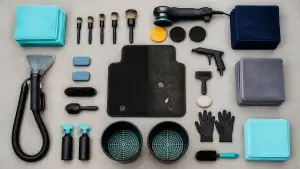
Fill one bucket with your soap solution and one with clean rinse water. Put a grit guard in both if you have them.
- Load the mitt from the soap bucket.
- Wash one panel, in straight lines, with almost no pressure. Let the soap do the work.
- Rinse the mitt in the clean water bucket before it goes back into the soap.
- Move top to bottom. Roof, glass, upper doors, hood, trunk, then lower doors and bumpers last.
The lower six inches of any vehicle is the dirtiest part of the car. It goes last, and ideally with a separate mitt. Wheels and tires get their own mitt or brush and never touch paint.
Step 4: Rinse again, sheet the water off
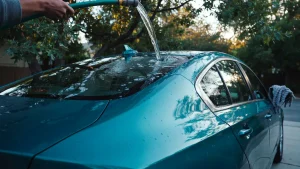
Rinse thoroughly from the top down. Then pull the nozzle off the hose and let a low-pressure open flow of water run over each panel. On a coated car the water will sheet off almost completely and take most of your drying work with it.
Step 5: Dry immediately
This is the step in how to wash a ceramic coated car that determines whether your coating looks great or spotted.
- Best: filtered forced air to blow water out of mirrors, badges, trim gaps, and lug nut recesses, then a light pass with a plush microfiber drying towel.
- Good: a large twisted-loop microfiber drying towel, laid on the panel and pulled gently, never scrubbed in circles.
- Never: letting it air dry, a chamois that has touched the ground, or an old bath towel.
If you are working in heat and a panel starts drying ahead of you, mist it with a coating-safe drying aid or detail spray and wipe it off. Do not chase it with water.
What to avoid on a ceramic coated car
- Brush-style automatic tunnel washes. Spinning nylon brushes carry grit from every vehicle ahead of you and will mar a coating in a single pass. This is the fastest way to ruin a $1,500 investment.
- Wax and wax-infused soaps. They fill the coating’s surface texture and kill beading. You will think the coating failed.
- Dish soap. It is a degreaser. It strips.
- Acidic wheel cleaners on paint. Fine on wheels if rated for your finish, not fine when overspray dries on a coated fender.
- Washing in direct sun on a hot panel. Soap and water flash-dry before you can rinse them.
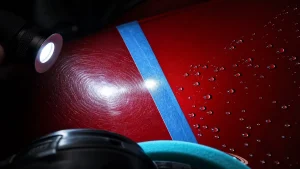
- Circular scrubbing. Straight lines only. Circular motion creates the swirl pattern you can see under LED lights.
Touchless automatic washes are a different story. They use no physical contact, so they are a reasonable option between proper washes, as long as the chemistry is not aggressively alkaline. They are not as good as a hand wash, but they will not scratch anything.
How often should you wash a coated car?
Every two weeks is the sweet spot for a daily driver in the Upstate. Every week during pine pollen season in late March and April, and after any drive through salt brine when SCDOT pretreats roads ahead of an ice event.
The point of a coating is not that you wash less often. It is that once you know how to wash a ceramic coated car, each wash takes a fraction of the time and effort, and contaminants come off before they have a chance to etch.
Twice a year, a coated car benefits from a decontamination wash: an iron remover to dissolve embedded brake dust, a pH-neutral coating-safe surface cleanser to strip anything bonded to the top of the coating, and a fresh topper to restore slickness. That is the service equivalent of an oil change for your paint.
If you would rather not do it yourself
Plenty of people love washing their own car. Plenty of people paid for a coating specifically so their car would look expensive without them spending Saturday morning on it.
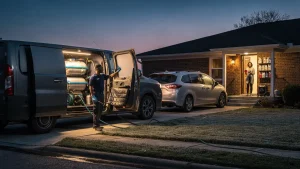
If you are the second kind, our monthly maintenance detailing plan is built for coated vehicles. We come to your house or your office, wash correctly with coating-safe chemistry, dry the car properly, and keep the coating performing the way it did the week it was installed. Plans are $150 per month per vehicle, with no contract and no cancellation fee.
We run this across Spartanburg, Greenville, Greer, Boiling Springs, Duncan, Lyman, Taylors, and Asheville.
Frequently asked questions about how to wash a ceramic coated car
Can you take a ceramic coated car through an automatic car wash?
Touchless automatic washes are acceptable between hand washes because nothing physically contacts the paint. Brush-style and soft-cloth tunnel washes are not. Those brushes carry embedded grit from every vehicle that went through before yours and will leave fine marring across a coating that then has to be machine polished out.
What soap should I use on a ceramic coated car?
When you are working out how to wash a ceramic coated car, start with a dedicated pH-neutral car shampoo with no wax, no gloss enhancers, and no polymer fillers. Many manufacturers sell a coating-specific maintenance shampoo. Avoid anything labeled wash and wax, avoid dish soap, and avoid high-alkaline traffic film removers, all of which either strip the coating or mask its hydrophobic behavior.
How often should I wash a ceramic coated car?
Every two weeks works for most daily drivers in the Upstate. Move to weekly during pine pollen season in late March and April, and wash promptly after exposure to road salt brine, bird droppings, or tree sap. Contaminants that sit for days can etch even a coated surface, so timing matters more than frequency.
Do I still need to wax a ceramic coated car?
No. A ceramic coating replaces wax entirely. Applying wax on top fills the coating’s microscopic surface texture, flattens the water beading, and makes people think the coating has failed when it has not. If you want to boost gloss and slickness, use a coating-compatible silicon dioxide topper or detail spray instead.
Why is my ceramic coated car still getting water spots?
Water spots on a coated car are almost always mineral deposits from hard water, not a coating failure. The coating repels water into beads, the beads sit on the surface, the water evaporates, and the dissolved calcium and magnesium stay behind. That is why drying immediately is the most important part of how to wash a ceramic coated car, and it prevents nearly all of them.
How do I remove water spots from a ceramic coating?
Start with the gentlest option: a coating-safe water spot remover or a diluted mineral-removal solution, applied to a cool panel and wiped with clean microfiber. If the deposits have etched into the coating, a light machine polish with a finishing pad may be needed, which removes a small amount of coating and usually means re-applying a topper afterward.
Can I pressure wash a ceramic coated car?
Yes, with sensible limits. Keep the pressure at or below roughly 1,200 to 1,500 PSI, use a wide 40-degree fan tip, and stay at least a foot away from the surface. Never hold a narrow tip close to paint, trim edges, or emblems. Pressure washing is for rinsing and pre-soaking, not for blasting dirt off.
How long should I wait before the first wash after a ceramic coating?
Wait about seven days. The coating continues to cross-link and harden after application, and washing too early can disturb the surface or leave spots that have to be polished out. Keep the vehicle out of rain for the first 12 to 24 hours, and avoid sprinklers, bird-heavy parking, and construction dust during the first week.
Does bird poop damage a ceramic coating?
It can if left. Bird droppings are acidic and will etch into a coating within hours in summer heat, leaving a dull ring. The coating buys you time, not immunity. Keep a bottle of coating-safe quick detailer and a microfiber towel in the car and remove droppings the same day you notice them.
How do I know if my ceramic coating is still working?
Rinse a clean panel and watch the water. A healthy coating makes water pull into tight, tall beads that roll off with a slight tilt, and the surface feels slick under a plastic bag test. If water sheets flat and clings, or the surface feels grabby, the coating is likely topped with contamination and needs a decontamination wash before you conclude it has worn out.
Keep the coating performing
A ceramic coating is only as good as the care behind it. Learn how to wash a ceramic coated car the right way and it will look installed-yesterday for years. Run it through a brush tunnel twice and you will be paying for correction again.
If you want it handled, call or text 828-333-0535. We wash coated vehicles the right way, at your house or your office, anywhere in Spartanburg and the Upstate.