Quick answer: Mobile car detailing is a full professional detailing service performed at your home or workplace instead of at a shop. The detailer arrives in a fully equipped vehicle carrying its own water supply, generator power, extraction equipment, and chemicals, and completes the same interior and exterior work you would get at a fixed location. You do not drop anything off and you do not need to provide a hose or an outlet.
The first question almost everyone asks is some version of “wait, how?”
How does someone deep clean a car in a driveway. Where does the water come from. What happens to the runoff. What if it rains. What if I live in an apartment. Is it as good as a real shop, or is this a guy with a bucket.
Fair questions, all of them. Here are the answers.
What mobile car detailing actually is
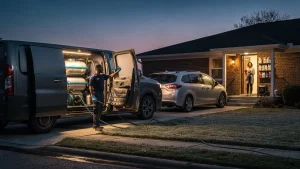
Mobile car detailing is the same trade as shop-based detailing, delivered at your location. The definition matters because two very different things get called “mobile” in this market.
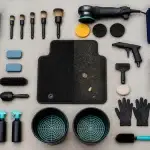
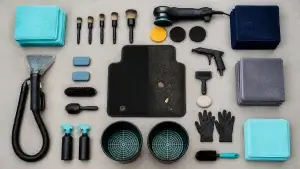
A mobile detailer arrives in a van, trailer, or truck carrying a water tank, a pressure washer, a generator or inverter power system, a hot water extractor, vacuums, polishers, lighting, and a full chemical inventory. They can perform interior deep cleaning, exterior decontamination, paint correction, and coating application at your location.
A mobile car wash shows up with a bucket and a hose and washes the exterior. Useful, cheaper, and a completely different service.
The distinction is the equipment. Detailing requires a hot water extractor for upholstery, dual-action polishers for paint, and a real water supply. If a service cannot bring those, it is a wash.
How mobile car detailing logistics work
Water
A properly equipped mobile unit carries its own water, typically 50 to 100 gallons, which is enough for one to three vehicles depending on the service. Many units also carry a deionized water system so the final rinse leaves no mineral spots.
You do not need to provide water. If a spigot is available and you offer it, most detailers will happily use it, but the job does not depend on it.
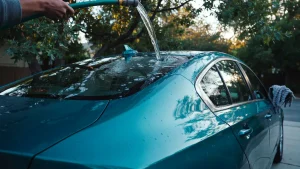
Worth noting: a professional mobile setup generally uses less water than a driveway wash with a garden hose running the whole time. The EPA’s WaterSense program points out that residential outdoor water use across the country accounts for nearly 8 billion gallons a day. A pressure washer with a controlled trigger moves far less water per minute than an open hose, and rinseless and low-water methods reduce it further.
Power
Generators or high-capacity battery and inverter systems run the vacuums, extractors, and polishers. A good mobile operator does not ask to plug into your house, and if noise is a concern near an office or during a baby’s nap, say so when you book. Battery-powered setups are quiet enough to run outside an open window.
Runoff
This is the question responsible customers ask and it deserves a straight answer. Professional detailing chemicals are used in small, controlled quantities, and a good operator manages rinse water so it soaks into landscaping or a permeable area rather than sheeting straight into a storm drain. Many jobs, especially interior work and rinseless exterior work, produce almost no runoff at all.
Space
A mobile detailer needs roughly one and a half parking spaces: room for the vehicle plus room to open every door fully and walk a polisher around the car. A standard driveway, a corner of an office lot, or an end space in an apartment lot all work.
Weather
This is the real constraint, and any honest mobile detailer will tell you so. Interior work happens in almost any weather. Exterior washing is fine in overcast conditions and light drizzle. What genuinely requires rescheduling is heavy rain, freezing temperatures, and, for ceramic coating work, anything that prevents a controlled cure window.
Good operators watch the forecast and call you before you have to call them.
What mobile car detailing can and cannot do
Handled at your location without compromise:
- Interior deep cleaning, extraction, and odor treatment
- Full exterior hand wash and decontamination
- Clay bar treatment
- Wheel, tire, and wheel well cleaning
- Engine bay cleaning
- Headlight restoration
- Wax and sealant application
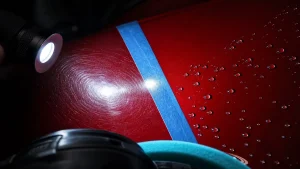
- Paint correction, given adequate space and lighting
Requires planning or a controlled environment:
- Multi-stage paint correction on severely damaged paint, which is a multi-day job
- Ceramic coating application, which needs stable temperature, low dust, and a protected cure window. This is schedulable at a home with a garage or under the right conditions, but it is not a drop-everything-and-do-it-now service.
Anyone who tells you every service is identical in every environment is overselling. The honest version: 90 percent of detailing work is location-independent, and the remaining 10 percent needs a conversation about scheduling.
Why people choose mobile car detailing over a shop
You do not lose a day. A shop detail means dropping off, arranging a ride, and going back. A mobile detail means the car is being worked on in your driveway on Highway 290 or your office lot on the Eastside while you do literally anything else.
You see the work. You can walk out mid-job and look. That transparency is uncomfortable for bad operators and completely fine for good ones.
The car does not get driven. Nobody else is putting miles on it or moving it around a lot.
Scheduling is easier. Early morning before work, mid-day at the office, or a weekend at home. A shop has fixed hours. A mobile detailer has a route.
It makes maintenance realistic. This is the underrated one. The reason most people fall behind on car care is logistics, not money. Remove the drop-off and a four-week maintenance schedule suddenly becomes something people actually keep.
What about apartments, condos, and HOAs?
Apartments: Usually fine. Check with your property management first, since some complexes restrict vehicle maintenance in common lots. Detailing is generally viewed differently from oil changes or repairs, but it is worth a two-minute call. An end space or a corner of the lot works.
HOAs: Most Upstate HOAs have no restriction on a detailer working in your own driveway. A few have rules about commercial vehicles parked in the neighborhood for extended periods. Again, worth checking once.
Office parking: Extremely common and usually the easiest option. Many employers are happy to have it happen, and several people on the same lot often book together.
Street parking: Workable if the space is safe and legal, though driveways and lots are better.
What to ask before you book a mobile detailer
- Are you insured? Anyone working on your vehicle at your property should carry liability coverage. Ask.
- Do you bring your own water and power? If the answer is that they need your hose and outlet, that is a mobile wash, not a mobile detail.
- What equipment is in the vehicle? You want to hear hot water extractor, dual-action polisher, and dedicated wash media. Not just a pressure washer and a shop vac.
- How do you handle weather? A real answer includes a rescheduling policy.
- How long will it take? A full detail is four to six hours. A two-hour quote for a full detail means something is being skipped.
- What do you need from me? The right answer is a parking spot and access to the vehicle.
How we run it
We run mobile car detailing only, across the Upstate. Everything comes with us: water, power, extraction, polishing, and lighting. You give us a parking spot and the keys and we handle the rest.
We work across Spartanburg, Greenville, Greer, Boiling Springs, Duncan, Lyman, Simpsonville, Mauldin, Taylors, and Asheville, including neighborhoods like Five Forks, Lake Bowen, and the Eastside. The full list of towns and coverage areas is on our service areas across the Upstate page.
Packages run from a $150 exterior detail to a $400 full detail, with paint correction from $400 and ceramic coating from $1,500. There are 142+ five star reviews behind that, most of them from driveways.
Frequently asked questions about mobile car detailing
What is mobile car detailing?
Mobile car detailing is professional interior and exterior detailing performed at your home or workplace rather than at a shop. The detailer arrives in an equipped vehicle carrying water, generator power, extraction equipment, polishers, and chemicals, and performs the same services a fixed location would. You provide a parking space and access to the vehicle.
Does mobile detailing use my water and electricity?
No. A properly equipped mobile detailer carries 50 to 100 gallons of onboard water and runs everything on a generator or battery inverter system. If you offer a spigot or outlet, most will use it as a convenience, but the service does not depend on either. Any operator who requires your hose is running a mobile wash, not a detail.
Is mobile detailing as good as a shop detail?
For interior work, exterior washing, decontamination, engine bays, headlights, and most paint correction, yes, the process and equipment are identical. The one area where a controlled environment helps is multi-stage correction on badly damaged paint and ceramic coating cure time, which get scheduled around weather and location rather than done on demand.
How much space does a mobile detailer need?
About one and a half parking spaces. Enough room to park the service vehicle nearby, open all of your car’s doors fully, and walk around the vehicle with equipment. A standard residential driveway, a corner of an office lot, or an end space in an apartment lot all work fine.
What happens if it rains on my appointment?
Interior detailing proceeds in almost any weather. Light drizzle and overcast conditions are fine for exterior work. Heavy rain, freezing temperatures, and ceramic coating applications require rescheduling. A good mobile detailer watches the forecast and contacts you in advance rather than leaving you waiting.
Can you detail my car at my apartment complex?
Usually, yes. Check with your property management first, since some complexes restrict vehicle work in common areas. Detailing is typically treated differently from repairs or oil changes. An end space or a less-trafficked corner of the lot gives enough room, and the whole job is self-contained.
Do I need to be home during a mobile detail?
Not necessarily. Many customers leave a key, point out where the car is parked, and go to work. Others prefer to be present so they can point out specific concerns. Either works. What matters is that the detailer has vehicle access and a confirmed parking spot before arriving.
How long does mobile detailing take?
An exterior detail runs two to three hours, an interior detail two to four hours, and a full detail four to six hours. Paint correction adds four to ten hours depending on paint condition. Pet hair, heavy staining, and larger vehicles extend every estimate, so mention those when booking so enough time gets scheduled.
Is mobile detailing more expensive than a shop?
Generally comparable. Mobile operators carry travel and equipment costs but avoid commercial rent, so pricing tends to land in the same range as a fixed shop. In the Spartanburg area, exterior details run about $150, interiors about $225, and full details about $400, which is consistent with shop pricing for equivalent work.
Does mobile detailing damage driveways?
No. Professional detailing chemicals are used in small, controlled quantities and diluted heavily. Some degreasers can lift existing oil stains on concrete, which occasionally makes a driveway look uneven afterward because it is cleaner in places. A good operator will point out any concerns before starting rather than after.
Get it done where your car already is
The best detail is the one that actually happens, and mobile car detailing is how it happens. If dropping a car off has been the reason yours has not been detailed in two years, that reason just went away.
Call or text 828-333-0535 to book. We come to you anywhere in Spartanburg, Greenville, Greer, and the surrounding Upstate.