Quick answer: What does car detailing include? A deep interior clean (full vacuum, shampoo or steam on seats and carpets, cleaning of every panel, vent, and crevice) plus an exterior process (hand wash, wheel and tire cleaning, clay bar decontamination, and a protective wax or sealant). A full detail combines both. It is a restoration process, not a car wash.
Most people book their first detail with no idea what they are actually buying. They know the car will be cleaner. They do not know whether $150 or $400 is the right number, why one shop takes two hours and another takes six, or whether the guy quoting $79 is a bargain or a warning sign. Most never ask the one question that matters: what does car detailing include?
So what does car detailing include, exactly? Here is the entire process, line by line, so you can read any menu and know exactly what you are getting.
Detailing is not a car wash
A car wash removes surface dirt. Detailing removes everything else.
The International Detailing Association, the global trade body for the profession, exists specifically because detailing is a skilled trade rather than a commodity service, with its own equipment, chemistry, and technique standards. That distinction shows up in the work.
| Car wash | Detailing | |
|---|---|---|
| Time | 5 to 15 minutes | 2 to 8 hours |
| Interior | Quick vacuum, maybe a wipe | Deep clean of every surface and seam |
| Paint | Soap and rinse | Decontamination, clay, correction, protection |
| Contact | Brushes or high-pressure jets | Hand wash, dedicated mitts per zone |
| Result | Clean until the next rain | Restored and protected for months |
| Purpose | Removes dirt | Removes what dirt left behind |
A wash gets the mud off. A detail gets the mud, the embedded brake dust, the bonded tree sap, the oxidation, the coffee stain from 2023, and the smell out.
What does car detailing include inside the vehicle?
When people ask “what does car detailing include,” the interior is usually what they mean. Interior work is the slower half and the half customers notice most, because you sit in it.
Removal and access. Floor mats out. Seats moved to their limits. Anything loose removed so the detailer can actually reach the footwells and under the seats.
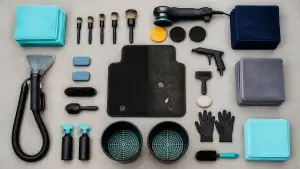
Full vacuum. Seats, carpets, headliner if needed, trunk or cargo area, and the crevices around the console and seat rails. Compressed air is often used first to blow debris out of seams where a vacuum nozzle will not reach.
Surface cleaning. Dashboard, instrument cluster, door cards, center console, cup holders, shift surround, and every switch. Done with detail brushes and a cleaner appropriate to the material, because the same product that is fine on hard plastic can stain leather or discolor piano-black trim.
Vents and crevices. Air vents cleaned individually with brushes. Seat rails, seat belt anchors, door jambs, and the gap between the seat and the console, which is where every french fry in history has ended up.
Upholstery treatment. This is where packages diverge:
- Light stain removal on a standard interior detail: spot treatment of visible marks.
- Hot water extraction or steam on a deeper package: pulls dirt out of the fibers rather than pushing it around. This is what actually removes odors.
- Leather cleaning and conditioning: pH-appropriate cleaner, then a conditioner that restores flexibility so the seat does not crack.
Glass, inside. Interior glass gets a dedicated pass. Windshield interiors build up a film from off-gassing plastics that most people never clean and then blame for night-driving glare.
Pet hair, if applicable. This is genuinely its own job. Embedded pet hair in cloth seats often takes longer than everything else combined, which is why most shops price it separately.
What does car detailing include on the exterior?
Pre-rinse and wheels first. Wheels and tires are cleaned before the body, because wheel cleaner overspray on a dirty panel is fine and on a freshly washed panel is not. Barrels, faces, lug recesses, tires, and wheel wells.
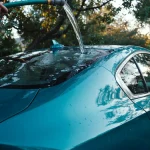
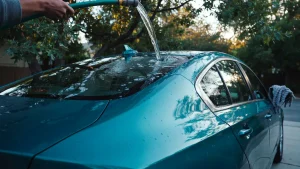
Hand wash, two-bucket method. Top to bottom, straight lines, separate mitts for upper panels and lower rockers. The bottom six inches of a vehicle carries the grit that causes scratches.
Chemical decontamination. An iron remover dissolves embedded brake dust and rail dust that a wash will not touch. You will see it turn purple as it reacts. A tar remover handles road tar on lower panels.
Clay bar treatment. A clay bar or synthetic clay mitt glides across lubricated paint and shears off bonded contaminants. Run your hand over your hood in a plastic bag right now. If it feels like fine sandpaper, that is what clay removes. Paint cannot be properly polished or protected until this is done.
Drying. Microfiber towels or filtered forced air. Air is better because it pulls water out of mirror housings, badges, and trim gaps that would otherwise drip onto clean paint an hour later.
Protection. A wax, a synthetic sealant, or a ceramic coating depending on the package. Wax lasts weeks. Sealant lasts months. A coating lasts years.
Finishing touches. Tire dressing, trim restoration on faded plastic, exterior glass, and door jambs wiped down.
The optional add-ons
What does car detailing include beyond the basics? These are separate services because they take real time and skill.
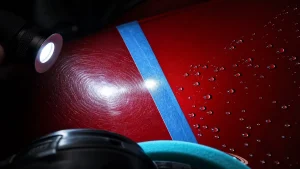
- Paint correction. Machine polishing to remove swirl marks and light scratches. Starts at $400 and scales with how bad the paint is and how many stages it needs.
- Engine bay cleaning. Degreasing and safe cleaning of the engine compartment, then dressing. Around $100. Worth it before a sale or an appraisal.
- Headlight restoration. Sanding and polishing cloudy, yellowed lenses back to clear, then sealing them. Around $100, and it does more for how a ten-year-old car looks than almost anything else.
- Odor removal and ozone treatment. For smoke, pets, or spills that soaked into the padding.
Interior, exterior, or full: which do you need?
| Package | Price | Best for |
|---|---|---|
| Interior detail | $225 | Kids, pets, spills, a cabin that has gotten away from you |
| Exterior detail | $150 | Dull paint, water spots, a car that looks older than it is |
| Full detail | $400 | First-time customers, pre-sale prep, an annual reset |
| Monthly maintenance plan | $150 per month | Upkeep on a car already in good shape, one visit per month |
Those are our published prices. The honest guidance: if this is your first detail on this vehicle, get the full detail. A maintenance detail is designed to keep a clean car clean. It is not built to recover a car that has been neglected for three years, and booking one for that job leaves everyone disappointed.
After the full reset, our monthly maintenance plan at $150 per month holds the result at a much lower cost, with no contract and no cancellation fee.
How long does detailing take?
- Interior detail: 2 to 4 hours
- Exterior detail: 2 to 3 hours
- Full detail: 4 to 6 hours
- Add paint correction: 4 to 10 hours on top
Pet hair, heavy stains, and large vehicles push every number up. Anyone promising a full detail in 90 minutes is doing a wash with extra steps.
Mobile detailing changes the equation
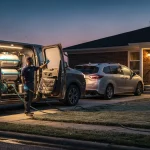
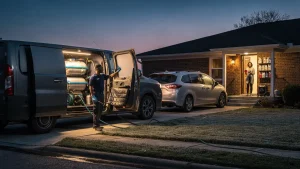
A traditional detail means dropping the car off, arranging a ride, and losing most of a day. Mobile detailing means the work happens in your driveway on Fairview Road or in your office lot off Wade Hampton Boulevard while you do something else.
We bring water, power, and everything else. You keep your day. What does car detailing include in each of our packages? See the full list of packages and what each one covers on our mobile detailing services in Spartanburg page.
We work across Spartanburg, Greenville, Greer, Boiling Springs, Duncan, Lyman, Simpsonville, Taylors, and Asheville.
Frequently asked questions: what does car detailing include?
What does a full car detail include?
A full detail combines the complete interior and exterior processes: full vacuum, surface and crevice cleaning, upholstery treatment, and interior glass, plus a hand wash, wheel and tire cleaning, iron and tar decontamination, clay bar treatment, drying, and a wax or sealant. Expect four to six hours and a result that resets the vehicle inside and out.
What is the difference between car detailing and a car wash?
A car wash removes loose surface dirt in about ten minutes. Detailing is a multi-hour restoration that removes bonded contaminants, cleans every interior surface and seam, and applies protection. A wash makes a car clean. A detail makes a car look and smell like it did when it was newer, and protects that result.
How much does car detailing cost?
In the Spartanburg area, an interior detail runs about $225, an exterior detail about $150, and a full detail about $400. Add-ons price separately: paint correction from $400, engine bay cleaning around $100, and headlight restoration around $100. Vehicle size, pet hair, and heavy staining move those numbers up.
Does car detailing include shampooing the seats?
It depends on the package. A standard interior detail typically includes a full vacuum and light stain removal. Hot water extraction or steam cleaning of seats and carpets is usually a deeper service or an add-on, because it takes significantly more time and equipment and requires drying time before the vehicle is comfortable to use.
Does detailing remove scratches?
Standard detailing does not. Removing swirl marks and light scratches requires paint correction, which is machine polishing with compounds and pads. It is a separate service starting at $400. Detailing will make existing scratches less visible by cleaning and protecting the paint around them, but it does not level the clear coat.
Does car detailing include the engine bay?
Usually not by default. Engine bay cleaning is a separate service, typically around $100, because it requires masking sensitive electronics, using appropriate degreasers, and controlled rinsing. It is worth adding before selling a vehicle or a trade-in appraisal, where a clean engine compartment signals that the car was cared for.
How often should I get my car detailed?
A full detail once or twice a year, with a maintenance detail every four to six weeks in between, keeps most daily drivers in excellent shape. Vehicles that live outdoors, carry kids or pets, or see heavy highway miles benefit from the shorter interval. Cars kept garaged can stretch it.
Will detailing get pet hair out of the seats?
Yes, though it is labor intensive. Embedded pet hair in cloth upholstery is removed with rubber tools, specialized brushes, and repeated extraction passes, and it can take longer than the rest of the interior combined. Most detailers price pet hair as an add-on for that reason, so mention it when you book so the time gets allocated.
Can detailing remove cigarette smoke smell?
Often, but it requires more than a standard interior detail. Smoke residue settles into upholstery, headliner, and the ventilation system. Full removal typically needs hot water extraction, headliner treatment, cabin filter replacement, and an ozone or enzyme treatment. Ask for an odor removal package rather than expecting a standard detail to solve it.
Is mobile detailing as thorough as a shop detail?
For interior and exterior detailing, yes. A properly equipped mobile setup carries its own water, power, extraction equipment, and lighting, and the process is identical. The one area where a controlled shop environment helps is multi-stage paint correction and ceramic coating cure time, which is why those jobs get scheduled around weather and location.
Book the detail your car actually needs
The real answer to “what does car detailing include” depends on your car, and the fastest way to get the right package is to tell us what is going on with the vehicle. Kids and juice boxes point one direction. Three years of parking under a pine tree point another.
Call or text 828-333-0535 and we will tell you honestly what your car needs and what it does not. We come to you anywhere in Spartanburg and the Upstate.